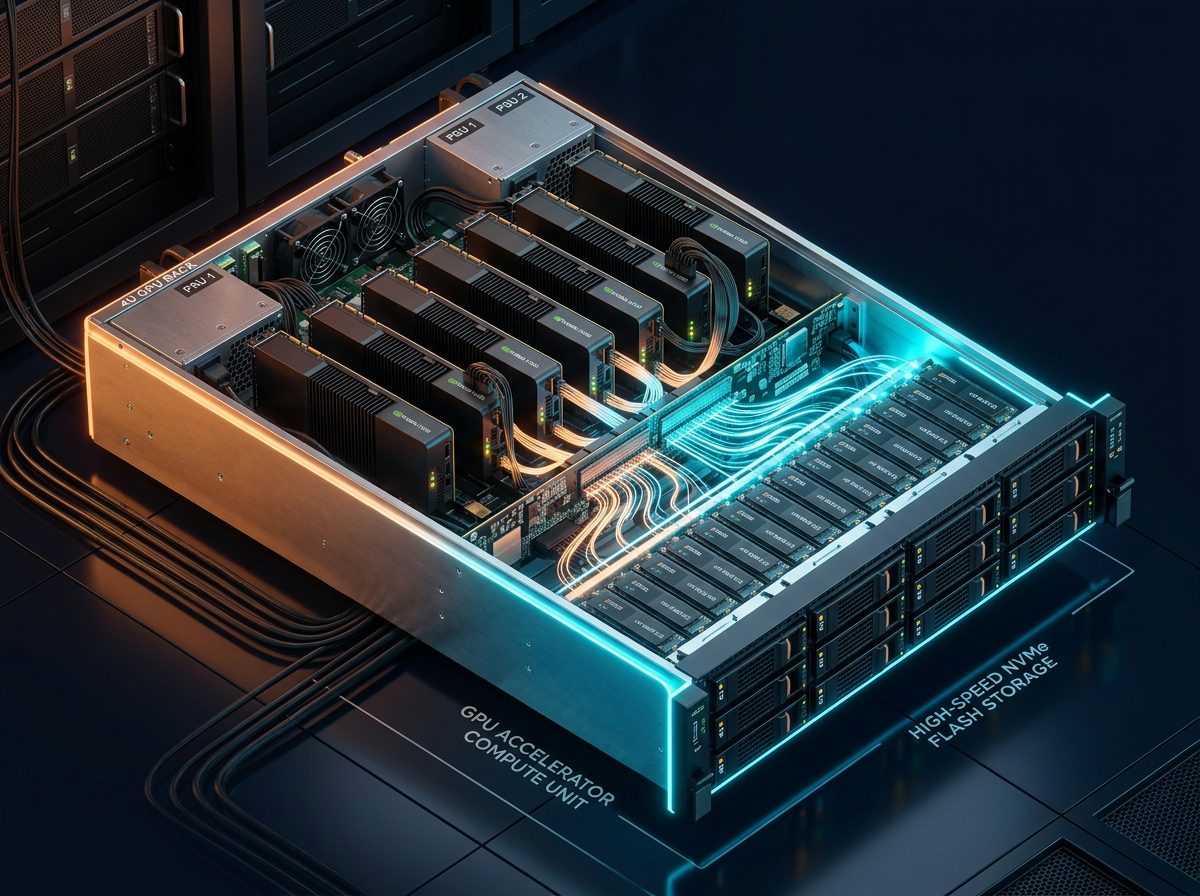
Purpose-built for GPU-adjacent storage. PCIe Gen4 fabric routes NVMe capacity directly to GPU-heavy hosts — no CPU bottleneck, no fabric hops.
AI training and inference stall when storage can't keep up. GPU Storage Infrastructure eliminates the storage tax by placing NVMe capacity on a PCIe Gen4 fabric that reaches GPUs directly.
Deploy NVMe capacity behind the same PCIe fabric that connects your GPU accelerators — with GPUDirect-friendly topology and DMA-optimised paths.

The block diagram shows how GPU Storage Infrastructure stitches a large NVMe pool directly onto the GPU fabric — bypassing CPU-side bottlenecks. GPUs peer with NVMe endpoints across the PCIe Gen4 fabric backplane (Tier-1 US PCIe switch silicon inside) using GPUDirect Storage. Training batches stream from SSD into HBM at bus-native throughput; the CPU is freed from I/O staging. Result: shorter training epochs, higher GPU utilisation, and lower cost-per-token for large-model training runs.
The connection diagram maps a typical GPU training row. Two or four GPU nodes each expose a PCIe HBA into the DF-S06 chassis via MCIO cables. The chassis houses the fabric plus a large NVMe pool. Front-end networking (200/400 GbE or IB) stays with the GPU nodes; DF-S06 does not sit in the data-network path. Management runs on a separate 10 GbE port. Use this diagram to plan GPU rack elevation, cable lengths, and PSU sizing when adding NVMe drives.
| Interface | Details |
|---|---|
| Host | PCIe Gen4 x16 to GPU host |
| Storage | 24× NVMe Gen4 |
| DMA model | GPUDirect-compatible |
| Management | DCIM · Redfish |
GPU-intensive AI training and inference are I/O-bound as often as they are compute-bound. Between epochs, models re-read datasets. Between requests, inference services fetch features. Every stall costs GPU utilisation.
GPU Storage Infrastructure places NVMe capacity behind the same PCIe fabric that the GPUs sit on. With GPUDirect-compatible topology, storage-to-GPU transfers can bypass CPU memory copies — a direct DMA path from NVMe to HBM.
The Datafabrix Gen4 Fabric Backplane provides the low-hop, deterministic fabric that makes this work. Combined with our reference GPU host designs, you get storage that keeps GPUs fed.
Consistent, high-throughput storage across a training cluster.
Low-tail-latency storage under production inference services.
Shared GPU-adjacent capacity for multiple researchers.
| Category | Specification |
|---|---|
| Fabric | PCIe Gen4 non-blocking · GPUDirect-friendly |
| Host lanes | PCIe Gen4 x16 to GPU host |
| Drives | 24× NVMe Gen4 |
| Latency | Sub-10 μs storage-to-host |
| Management | DCIM-native |
Where it fits in the rack, how it connects, and what you get after installation.
PCIe Gen4 backplane wired directly between GPU accelerators and NVMe storage — line-rate GPU-to-flash. The solution slots into a standard 19-inch rack alongside your existing servers, storage, and network fabric — no re-architecture required.
Target deployments: GPU compute where I/O to storage is the training-loop bottleneck.
Slide the DF-S06 chassis into a standard 19-inch rack slot. Rail kit included. Cable to your PDU and management network.
Install the Datafabrix PCIe host adapter in your existing server. Connect via PCIe cable to the DF-S06 backplane uplink.
Insert NVMe drives, GPUs, or accelerators into hot-plug slots. Each device trains and appears as a native PCIe endpoint on the host.
Optional: connect to Datafabrix DCIM for fleet-wide visibility. Add more chassis for horizontal scale — no host reconfiguration.
Direct rack integration alongside your existing production servers. Turnkey in a single deployment window.
Scale from a single chassis pilot to full-rack production with zero architectural change.
OEM-ready configuration for organizations building their own branded infrastructure products.
Engineering pilots, reference designs, and OEM co-design programs — we work with your team from concept to production.