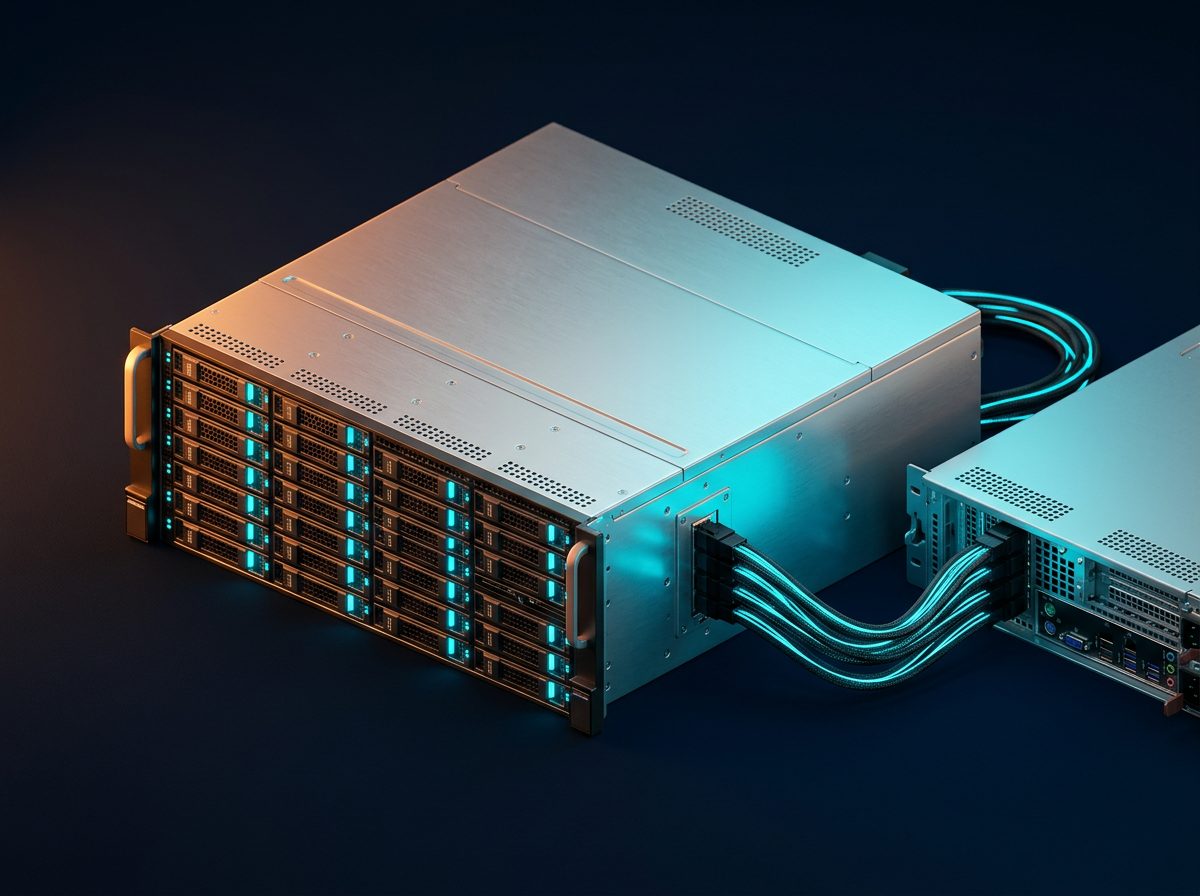
Aggregate hundreds of NVMe drives behind a single PCIe Gen4 fabric — engineered for the throughput and IOPS AI training pipelines demand.
A PCIe Gen4 fabric backplane (Tier-1 US PCIe switch silicon inside) that pools NVMe capacity behind a single high-bandwidth interconnect — feeding GPU-heavy training pipelines with the IOPS and sustained throughput they demand.
Deployable as an expansion chassis to your existing AI cluster, or as a purpose-built storage tier. Hot-plug drive replacement, HA-capable topology, and a fabric that scales linearly with drive count.

The block diagram shows how the AI Storage Expansion Platform inserts a PCIe Gen4 fabric backplane (Tier-1 US PCIe switch silicon inside) between AI hosts and a large NVMe SSD pool. GPU/Xeon hosts each carry a 16-lane PCIe Gen4 host bus adapter that cable-attaches into the fabric. The switch fabric multiplexes host requests across 24 hot-plug NVMe slots, exposing the pool as native PCIe endpoints — no protocol translation, no network overhead. Result: near-local-NVMe latency at rack-scale capacity for LLM training and RAG workloads.
The connection diagram is the physical map of a typical deployment. Two GPU host servers each mount a PCIe HBA whose external MCIO cables run to the DF-S01 chassis in an adjacent rack slot. The chassis houses the fabric backplane plus 24 NVMe drive bays. Management traffic exits over a dedicated 10 GbE port to the Datafabrix DCIM. Use this diagram to size cable lengths (≤3 m passive, 3–7 m active), plan rack elevations, and verify PSU wattage against the drive population.
| Interface | Details |
|---|---|
| Host interface | PCIe Gen4 x16 (2× cable-connected) |
| Downstream | 24× U.2/U.3 NVMe bays |
| Management | SES-3 / SES-2 · Redfish over sideband |
| Hot-plug | Supported (per-slot) |
| HA | Dual host cabling · MPIO |
| Power | Dual PSU · N+1 redundancy |
The AI Storage Expansion Platform is a PCIe Gen4 fabric that aggregates 24 NVMe drives into a single logical storage pool. Two host cables carry PCIe Gen4 x16 lanes upstream, delivering 128 GB/s of aggregate bandwidth to the AI compute node.
The Datafabrix Gen4 Fabric Backplane at the heart of the enclosure performs non-blocking PCIe switching. Each downstream slot is fully independent — hot-plug replacement, per-drive telemetry, and lane-width negotiation happen without disturbing the fabric.
For HA deployments, a second host cable can be attached from a peer node. MPIO on the host redirects I/O around any single point of failure. The platform integrates natively with the Datafabrix DCIM Platform for fleet-wide visibility.
Feed multi-GPU training nodes with terabytes/sec of dataset throughput.
Sustain image-classification workloads with millions of tiny reads.
Serve retrieval-augmented-generation feature stores at low latency.
| Category | Specification |
|---|---|
| Fabric | PCIe Gen4 non-blocking switch |
| Host lanes | 2× PCIe Gen4 x16 (128 GB/s aggregate) |
| NVMe bays | 24× U.2/U.3 (Gen4) |
| Hot-plug | Per-slot |
| Power | Dual PSU · N+1 |
| Management | Redfish · DCIM-native |
| Form factor | 2U rack chassis |
Where it fits in the rack, how it connects, and what you get after installation.
24-slot NVMe expansion chassis connected to your GPU/AI training host via PCIe Gen4 fabric. The solution slots into a standard 19-inch rack alongside your existing servers, storage, and network fabric — no re-architecture required.
Target deployments: AI training clusters where GPU compute is starved for storage bandwidth.
Slide the DF-S01 chassis into a standard 19-inch rack slot. Rail kit included. Cable to your PDU and management network.
Install the Datafabrix PCIe host adapter in your existing server. Connect via PCIe cable to the DF-S01 backplane uplink.
Insert NVMe drives, GPUs, or accelerators into hot-plug slots. Each device trains and appears as a native PCIe endpoint on the host.
Optional: connect to Datafabrix DCIM for fleet-wide visibility. Add more chassis for horizontal scale — no host reconfiguration.
Direct rack integration alongside your existing production servers. Turnkey in a single deployment window.
Scale from a single chassis pilot to full-rack production with zero architectural change.
OEM-ready configuration for organizations building their own branded infrastructure products.
Engineering pilots, reference designs, and OEM co-design programs — we work with your team from concept to production.